

Imagine two conference rooms. In the first, your tech team is presenting an impressive AI agent: it purchases, recommends, manages, and handles customers - automated, measurable, fast. In the second room sits your customer, still not convinced they want a machine making decisions for them. The problem? Most organizations only ever walk into the first room.
Q1 2026: Research from Riskified finds that consumer comfort with fully autonomous AI purchasing has declined sharply from late 2025 levels - driven by concerns over fraud, security, and unclear accountability when things go wrong.
June 2026, just a few months later: Accenture publishes a survey of 25,590 consumers across 16 countries and finds that 74% would trust a personal AI agent more than their best friend to make a purchase on their behalf.
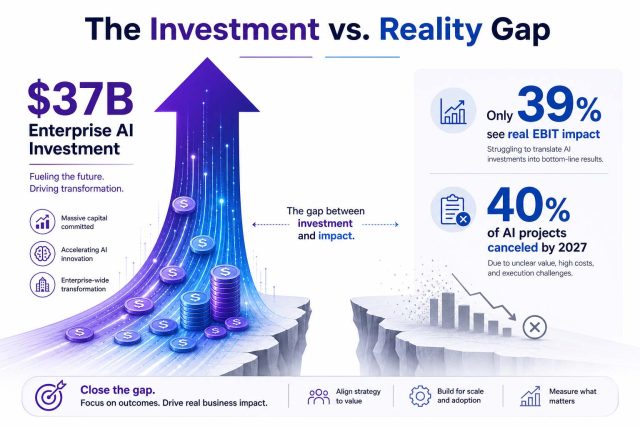
Both findings are real. Neither is wrong. They simply measure entirely different things - and that's precisely the trap organizations fall into when planning their AI strategy for 2027. Because while the research is still debating, the money is already moving: enterprise generative AI spending jumped from $11.5 to $37 billion in a single year.
This is the gap every CMO needs to understand - before signing off on the next budget.
The Money Is Already Moving
According to Menlo Ventures' "State of Generative AI in the Enterprise" report, enterprise generative AI spending surged from $11.5 billion in 2024 to $37 billion in 2025 - a 3.2x increase in a single year, with more than half of that sum ($19 billion) flowing into the application layer. Gartner estimates that by 2030, approximately $234 billion in enterprise software spending could "change hands" as autonomous agents perform tasks directly, bypassing traditional user interfaces.
(A note for those who want to dig deeper: market size estimates for "agentic AI" vary significantly across research firms, with no consistent definition of what the category actually includes. Any single number on this topic should be treated with caution.)
According to Deloitte, 74% of companies plan to deploy agentic AI within two years. But here's where the story gets interesting: only about one in five senior executives report having a mature governance model for autonomous agents. The gap between expectation and reality is equally stark when it comes to returns: in a PagerDuty survey, organizations project an average ROI of 171% on agentic AI investments - lofty expectations that haven't yet been tested against reality. A separate McKinsey study found that only 39% of organizations can currently attribute measurable impact on operating profit to AI. Gartner itself predicts that more than 40% of agentic AI projects will be shut down by the end of 2027 - primarily due to cost overruns, unclear business value, and inadequate risk controls.
In short: organizations are moving faster than they can build, measure, or govern.
The Consumer? Depends Who You Ask
This is the part that should be flashing red. In less than a year, four separate consumer studies reached conclusions that point in very different directions:
-
Accenture (June 2026): 74% of consumers - surveyed across 25,590 respondents in 16 countries - said they would trust a personal AI agent more than their best friend to make a purchase on their behalf.
-
Riskified (Q1 2026): Found a sharp decline in consumer comfort with fully autonomous AI purchases compared to late 2025 levels. Key concerns cited: fraud risk, security vulnerabilities, and unclear accountability when something goes wrong. (Worth noting: Riskified is an e-commerce fraud prevention company - not a reason to dismiss the findings, but a solid reason not to treat them as your only source.)
-
Quad/Harris Poll (April 2026): Found significantly lower trust levels for autonomous, high-value purchases - with a large majority of respondents saying they would lose trust in a brand if they discovered AI recommendations were in fact paid placements in disguise.
-
Checkout.com (June 2026): Found that a meaningful share of consumers would never delegate purchasing decisions to AI under any circumstances — while the vast majority of merchants believe consumers will adopt agent-guided shopping faster than consumers themselves expect. (Also worth noting: Checkout.com sells payment infrastructure for agentic commerce - the "gap" finding aligns with their product positioning.)
Four serious studies. Four different methodologies. Four sets of conclusions that don't fully align. And that's exactly the point: the market hasn't settled into a stable position yet. Anyone building a 2027 marketing strategy on a single data point is taking a very real risk.
Why the Data Contradicts Itself
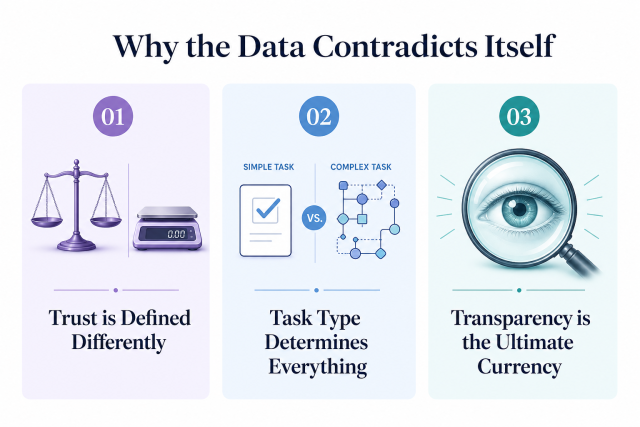
There are three structural reasons for the disconnect - all directly relevant to strategic planning:
1. "Trust" is measured by different definitions. When Accenture asked about purchasing with a personal AI agent acting on the consumer's behalf, it found strong willingness. When other researchers asked about fully autonomous purchases without consumer oversight, comfort dropped significantly. These aren't the same question, even if both claim to be studying "AI agents."
2. The type of task is everything. There's a world of difference between "let AI renew my streaming subscription" and "let AI book me an $800 flight without asking." Most of the positive data points refer to the former. Most of the concerns point to the latter.
3. Transparency is the ultimate currency. Research consistently shows that consumers are willing to abandon trust the moment they suspect sponsored results are hidden inside an AI recommendation. This is precisely the risk every brand investing in agentic commerce needs to design around from day one - not as a bug fix, but as a core product feature.
What This Looks Like in Practice: Signals from the Field
The evidence from e-commerce points in a clear direction: trust signals work. Studies consistently show a measurable positive correlation between visible, recognizable trust indicators on e-commerce sites and conversion rates - making trust infrastructure a revenue-relevant investment, not just a compliance checkbox.
The generational divide is also significant, and it matters strategically. Younger consumers — particularly Gen Z and Millennials - consistently show higher comfort with AI-powered purchasing tools than older generations. A one-size-fits-all trust strategy across age groups is flawed at its foundation. The implication: both your messaging and the level of autonomy you offer should be segmented by audience, not standardized across it.
The Diagnostic Questions Every CMO Should Ask Right Now
Before defining any strategy, it's worth running a quick internal scan. Six questions that create an honest picture:
On the product and customer:
- In which product categories do we already see strong customer willingness to engage with AI - chatbots, recommendation engines, search? These are the natural entry points for agentic AI.
- What's the average amount a customer would be comfortable approving without manual sign-off - $50? $500? $5,000? That threshold defines the boundary of acceptable automation.
- Do we have behavioral data — not just surveys — on how customers react when they discover a recommendation was paid for? That's the real signal for trust risk.
On the organization:
- Who is currently accountable for AI decisions that affect end customers - and has the authority to stop them? If the answer is "unclear," there's a governance problem.
- Does the marketing team have direct, real-time access to AI performance data, or does it depend on IT for every report? Without visibility, there's no real ability to manage.
- Are the success metrics for AI projects defined in terms of EBIT, revenue, and customer retention - or only in query volume and pilot satisfaction scores? Pilot metrics don't automatically translate into business impact.
What to do with your answers:
0–1 "unclear" - Good readiness: The foundation exists. Move forward with deployment and build in regular quarterly reviews.
2–3 "unclear" - Blind spots: Identify the specific gaps and address them before scaling further.
4 or more "unclear" - Stop: Deployment is premature. The risk of brand and operational damage outweighs the projected benefit at this stage.
Five Strategic Recommendations for 2027 Planning
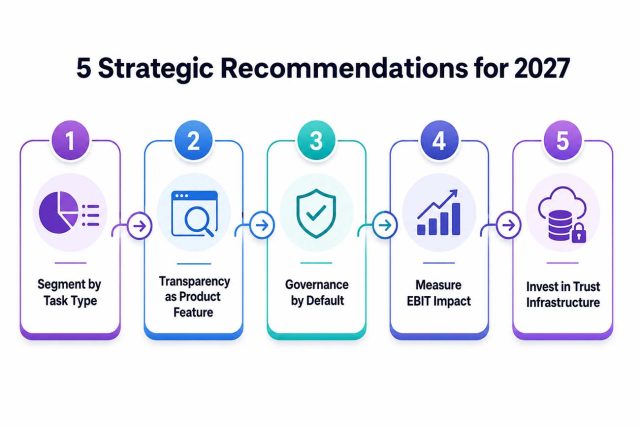
1. Stop planning around "average trust" — segment by task type
Don't ask "Do consumers trust AI?" Ask "Which decisions, at what value, and at what stage of the journey?" Build a risk-trust map by product category and action type — recommendation vs. execution, routine renewal vs. one-time major purchase — and prioritize automation where trust already exists.
In practice:
For leadership: Build a two-axis matrix - X-axis: transaction value; Y-axis: reversibility of the action. Low-value decisions that are easy to undo are candidates for full automation. High-value or irreversible decisions require human approval by default. This matrix drives your development priorities.
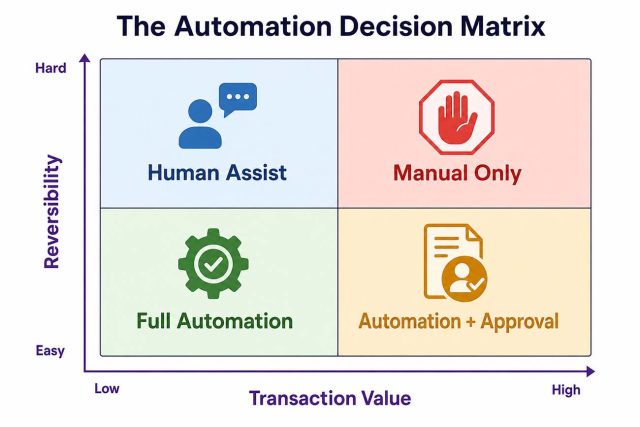
For the team: Map every customer touchpoint into one of four categories: full automation / automation with approval / human-assist / manual only. That document is your six-month roadmap - and it will prevent a lot of internal debate down the line.
2. Make transparency a product feature, not a terms-and-conditions clause
Research consistently shows that consumers are ready to abandon trust the moment they suspect sponsored content is hidden inside AI recommendations. Every AI-driven mechanism shown to customers must clearly disclose when a recommendation is neutral and when it's paid. Investing in transparency today is insurance against a trust crisis tomorrow. A quick gut check: if there were a news headline about the recommendations your AI delivers - would you be embarrassed?
In practice:
For leadership: Define your AI disclosure policy before launch - not after. Put three questions in writing: What is the AI recommending? What's the basis for the recommendation? Is there a commercial relationship involved? The answers must be accessible to the customer within three clicks. If you can't answer them clearly - the product isn't ready for market.
For the team: Add clear labeling - "AI-powered" or "automated recommendation" - to every piece of content generated or filtered by AI. Before launch, run a usability session with five real customers: can they tell when they're receiving an AI recommendation versus a human one? If not - go back to the drawing board.
3. Build governance and "human-in-the-loop" controls as the default - not as an afterthought
With only 21% of senior executives reporting a mature governance model, and Gartner projecting that more than 40% of projects will be shut down by 2027, governance isn't a "phase two" initiative. It's a non-negotiable requirement from day one - especially at high-stakes decision points: large purchases, cancellations, sensitive data.
In practice:
For leadership: Define in writing, before launch, three clear categories: (a) decisions the AI can make autonomously, (b) decisions the AI proposes that require human approval, (c) decisions the AI is never authorized to make under any circumstance. Assign clear ownership for each category - and schedule a standing quarterly review.
For the team: Build a control dashboard that shows in real time which decisions the AI made, at what value, and what the outcomes were. Without that visibility, governance is just a policy document. Also define a clear "stop button" - a mechanism that allows anyone on the team to pause a suspicious AI action and escalate it immediately.
4. Measure operating profit impact, not just pilot metrics
The gap between 171% projected ROI and the 39% of organizations that actually achieve measurable EBIT impact is a clear warning. Set real business success metrics before launch, not after. A pilot with impressive NPS scores that doesn't move revenue or retention isn't a success story - it's a measurable win hiding a business failure.
In practice:
For leadership: Require every agentic AI budget proposal to include three specific business metrics - not NPS, not usage volume — along with a mandatory 90-day interim review. If the team can't define those metrics before launch, that's a signal the initiative isn't ready.
For the team: Connect AI actions to CRM and revenue data from day one — not retroactively. Ask one simple question: "If we switched the agent off tomorrow, would we see it in the revenue report?" If the answer is no - real measurement hasn't started yet
5. Invest in trust infrastructure the way you invest in media
Trust signals — visible badges, identity verification, and clear "easy cancel" policies — have a measurable impact on conversion rates and customer confidence. This is no longer a peripheral technical expense. It's a brand-level marketing investment that deserves its own budget line and executive attention.
In practice:
For leadership: Allocate a separate budget line for "trust infrastructure" — not inside the tech budget, not inside media. Trust is a brand asset. A dedicated budget ensures it doesn't get traded away in internal prioritization battles.
For the team: Before broad deployment, run A/B tests on three elements: a visible trust or certification badge, a cancellation policy written in plain language, and a "Why did the AI recommend this?" button. Measure the impact on conversion rate and drop-off — and bring those results to your next AI budget conversation.
Three Common Mistakes Worth Avoiding
Mistake #1: "Launch and see" - piloting without predefined success criteria.
Many organizations launch a pilot, collect generally positive feedback, and then struggle to justify scaling — or stopping. The fix is simple: define upfront what "success" looks like and what "stop" looks like. Without a clear benchmark set before launch, every pilot will appear to succeed.
Mistake #2: "The generational assumption" - treating all consumers as equally ready.
Younger consumers consistently show higher comfort with AI-powered purchasing than older generations. A single strategy for all audiences will miss at least one major segment. Segment both your messaging and the level of autonomy you offer - because one size genuinely doesn't fit all.
Mistake #3: "Governance later" - deferring governance questions until after launch.
In virtually every failed project, governance arrived too late. Defining AI boundaries is a pre-launch conversation, not a post-incident response. Invest a couple of weeks in that discussion before going live — and save months of painful backtracking later.
The Bottom Line
The real race of 2026–2027 isn't "who deploys agentic AI first." It's an entirely different competition: who earns customer trust faster than their competitors lose it.
The organizations that win won't be the ones with the most sophisticated agent. They'll be the ones who understood that technological capability and consumer readiness are two entirely separate dimensions - and that any CMO planning for 2027 needs to plan for both, not just the first.
Sources: Menlo Ventures ("State of Generative AI in the Enterprise 2025"); Gartner; Deloitte ("State of AI in the Enterprise 2026"); McKinsey ("The State of AI 2025"); PagerDuty ("Agentic AI Survey 2025"); Accenture Consumer Pulse Research 2026. Additional references to Riskified, Quad/Harris Poll, and Checkout.com reflect published research findings; specific figures from these sources could not be independently verified at time of publication and have been cited directionally rather than quantitatively.
