

Nearly 60% of Google searches today end without a single click. That number should raise a red flag, but not cause panic. There's no need to write off SEO, it continues to evolve in ways we haven't seen in years.
The past was much simpler: high ranking = high traffic. Today, the equation is more complex.
AI systems like ChatGPT, Gemini, Perplexity, and Google SGE provide direct answers based on content they trust. If your content isn't structured so these systems can understand, cite, and recommend it, you're losing visibility even if you rank first.
It's not SEO or GEO - it's SEO + GEO together, a combination of traditional search engine optimization and optimization for AI systems shaping tomorrow's search experience.
The New Reality: From Search Results to Smart Answers
Modern search is fundamentally different. Google Search Generative Experience (SGE), ChatGPT, Gemini, Claude, and Perplexity no longer just return a list of links. They generate contextual, conversational answers based on understanding user intent, not just keyword matching.
What does this actually mean for you? Your content could rank first on Google and still get zero traffic if the AI decides not to cite you in its answer.
This shift has created a new discipline: GEO (Generative Engine Optimization), optimization not for search engines, but for AI systems that curate and recommend content.
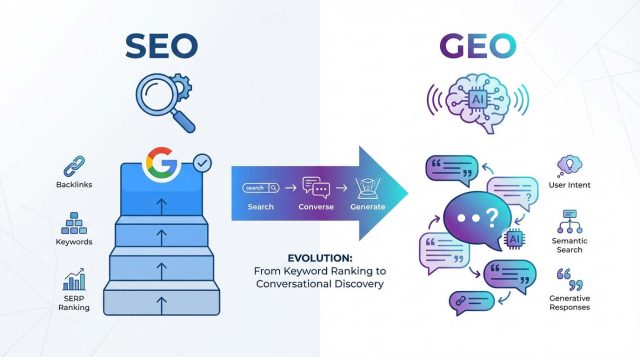
The Difference Between SEO and GEO
Traditional SEO focused on getting Google to find and rank your content. Success meant appearing on the first page.
GEO focuses on getting AI systems to cite, trust, and recommend your content as part of their answers. Success means becoming part of the conversation itself.
The difference? SEO optimizes for algorithms. GEO optimizes for understanding and credibility.
5 Practical Ways to Optimize for GEO
The good news? You don't need a complete overhaul or a huge budget. These five strategies work together to transform how AI systems discover and recommend your content.
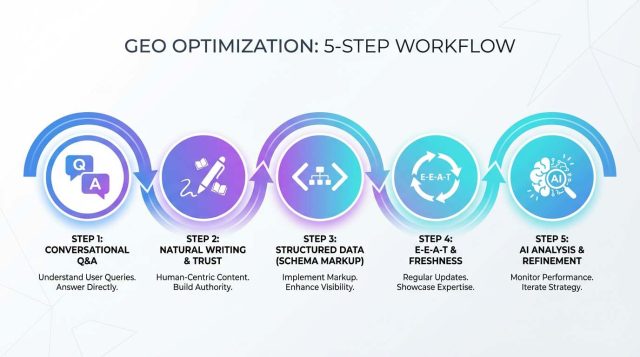
- Answer Direct Questions - Like a Human
AI systems prioritize content that provides clear, direct answers to specific questions.
Before:
"Our digital marketing services include comprehensive solutions including paid campaign management, search engine optimization, and advanced content strategy."
After:
"How long does it take to see results from a Google Ads campaign? Typically 2-4 weeks for meaningful initial data. In the first two weeks, we collect data and perform daily optimization. From the third week on, you'll see clear performance trends."
What to do: Add FAQ sections to every service page. Answer the questions your customers actually ask (check emails, chats, and Google Search Console).
- Write Like You Talk - Not Like a Robot or Ad
AI models are trained on natural language. Overly formal or keyword-stuffed content confuses them.
Before:
"Our organization provides integrative solutions for optimizing digital presence with data-driven methodology."
After:
"We help you reach the right customers through Google and social networks. We build strategy based on your data, not guesswork. Think of it as GPS for marketing - showing you exactly where to go and how to get there."
What to do: Read your content out loud. If it sounds robotic, change and rewrite the text.
- Implement Schema Markup - AI's Navigation System
Schema markup is structured data that tells AI exactly what your content is about: services, reviews, location, pricing.
Example for digital marketing business:
{
"@context": "https://schema.org",
"@type": "ProfessionalService",
"name": "Company Name",
"description": "Digital marketing Company...",
"address": {...},
"areaServed": "USA",
"serviceType": ["Google Ads", "SEO", "Social Media Management"]
}
FAQ Schema example:
{
"@context": "https://schema.org",
"@type": "FAQPage",
"mainEntity": [{
"@type": "Question",
"name": "How long does it take to see SEO results?",
"acceptedAnswer": {
"@type": "Answer",
"text": "Typically 3-6 months for significant improvement..."
}
}]
}
What to do: Use Google's Schema Markup Generator and test with Rich Results Test. Focus on LocalBusiness, FAQ Schema, Service Schema.
- Keep Content Fresh, Original, and Trustworthy (E-E-A-T)
AI systems prioritize current, unique information from credible sources. Google measures this through E-E-A-T: Experience, Expertise, Authoritativeness, Trustworthiness.
What works:
- Update articles frequently with new data and 2026 statistics
- Add unique insights from your experience and knowledge - case studies, lessons, internal data
- Include current trends and relevant examples
- Present content authors - name, role, professional background
For example: Instead of "Google Ads best practices" (covered everywhere), write "What we learned from managing 200+ Google campaigns for Israeli businesses in 2025-2026" (unique, relevant, trustworthy).
- Use AI Tools to Understand User Intent
You need to think like AI to optimize for it.
Practical workflow:
- Ask ChatGPT or Gemini: "What does someone searching for [your keyword] really want to know?"
- Use that to build your content
- Run the draft through AI and ask: "Would you recommend this content to answer [question]?"
- Improve based on feedback
Tools: ChatGPT for intent analysis, Surfer AI for semantic keywords, Clearscope for content gaps.
Technical Foundations: Make Your Site AI-Readable
Even excellent content fails if AI can't access it.
Essential checklist:
- robots.txt - allows AI crawlers: GoogleBot, GPTBot, Bingbot, PerplexityBot
- sitemap.xml - updated and submitted
- Content not hidden behind JavaScript - AI reads HTML
- Fast load speed (ideally under 3 seconds)
- Clear, defined heading hierarchy (H1 → H2 → H3)
- Mobile optimization - most AI training data is mobile-first
Why this matters: If AI can't easily parse your content, it won't cite it, regardless of quality.
For Managers and Decision-Makers - The Business Case:
Let's talk numbers and timelines, because strategy without context is just theory.
The cost of inaction is heavy. Businesses ignoring GEO will see 30-50% traffic drops over the next 12-18 months as AI-powered answers gradually replace traditional search results. This isn't a distant threat - your competitors implementing GEO strategies now are already capturing customers who would have found you six months ago.
The investment is reasonable - you're looking at 2-3 months for initial content reorganization and technical optimization, followed by ongoing improvement. Compare that to the cost of rebuilding your entire digital presence after losing visibility, or worse, watching market share erode while you play catch-up. The initial effort is far less expensive than recovery.
Results don't happen overnight, but they compound quickly - you'll see initial progress within about 60-90 days: appearance in AI citations, improved clicks from enhanced snippets, initial voice search visibility. The real payoff comes over 12+ months as AI systems learn which sources to consistently trust and recommend. Market leaders gain lasting advantage because they're training the AI infrastructure that will dominate search for years.
Here's the real risk - exclusion from AI answers means losing your most valuable traffic. These aren't casual browsers - they're users at the decision stage, asking specific questions with high purchase intent. AI answers target exactly these high-conversion searches. If you're not part of the answer, you've lost the customer before they even know you exist.
The bottom line - this isn't a marketing trend you can wait out. It's infrastructure, like mobile optimization that began in 2010. Companies that adapted early didn't just survive - they dominated their markets for years while competitors scrambled to close the gap. The same dynamic is happening now with GEO.
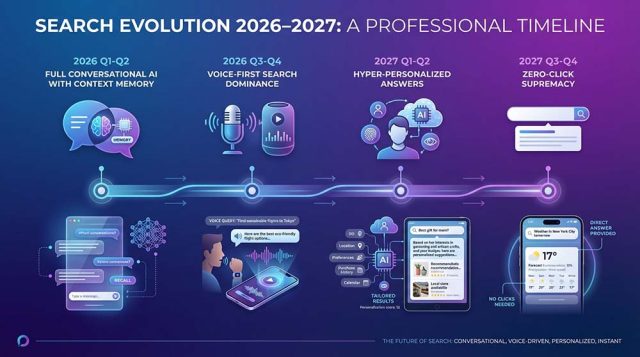
What's Coming in 2026-2027?
Search is evolving toward:
- Full conversational AI that remembers context between queries
- Voice-first search through devices and personal assistants
- Hyper-personalized answers based on user history, location, and preferences
- Zero-click dominance - answers delivered without leaving the search interface
"Rankings" as we know them won't exist. Visibility will mean citation by AI, recommendation in voice results, or appearance in personalized answer feeds.
Brands starting now, creating clear, structured, trustworthy content, will dominate this space. Those waiting will be invisible.
The Shift - From Traffic to Trust:
The old SEO playbook was about adapting content to algorithms. The new one is about winning AI's trust as a credible source.
Here's how to do it right:
- Create content that genuinely helps people (AI knows the difference)
- Build it so machines can understand context and relationships
- Keep it accurate, current, and original
- Build authority through consistent expert-level insights
- Show who's behind the content and their experience
Think of it this way: SEO convinces Google you're relevant. GEO convinces AI you're trustworthy.
What Should You Do Right Now?
- Audit one high-value page - Does it answer direct questions? Is it conversational? Does it have schema markup?
- Ask AI about your content - Paste your key pages into ChatGPT and ask "Would you recommend this content to someone searching for [topic]?"
- Check technical settings - Are AI crawlers blocked? Is your sitemap current? Is your site fast?
The Bottom Line
Remember when "mobile-first" sounded like an exaggerated buzzword? Companies that ignored it in 2010 spent the next decade running and trying to close the gaps. We're at exactly that moment now, except this time, the change is happening faster and bigger.
AI isn't coming to change search. Truth is, it's already doing it. The question isn't whether to adapt, but whether you'll do it while you still have traffic to protect, or after you've missed the boat and lost it.
The good news? You don't need to rebuild everything overnight. Start with one page, one FAQ section, one schema implementation. Small steps compound quickly when you're moving in the right direction.
AI is choosing its trusted sources now. Make sure you're one of them.
