

Picking an SEO tool feels like choosing a business partner these days. The landscape is packed with options, but two names keep coming up in every conversation: Semrush and Moz. If you're torn between them, you're definitely not alone. Semrush has racked up over 2,660 reviews with a solid 4.5/5 rating on G2, while Moz Pro sits at 4.3/5 from 569 reviews. Both have their passionate advocates.
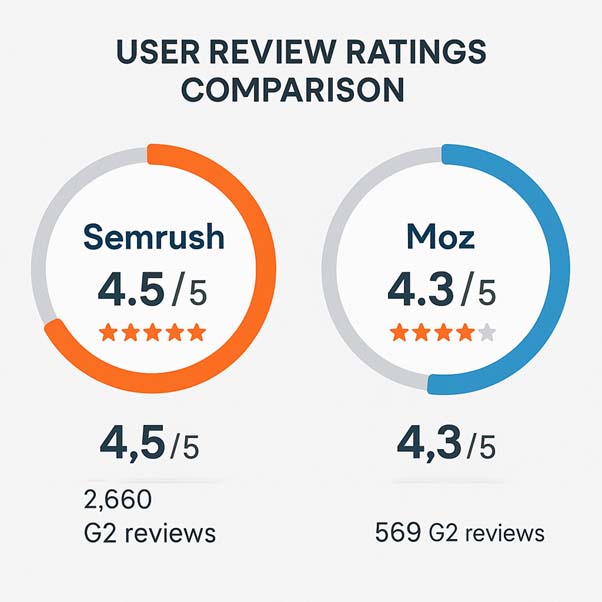
But here's the thing, those numbers only tell part of the story. I've spent time digging through user feedback, scrolling through Reddit threads (you know how brutally honest those can be), and really getting into the weeds with both platforms. This comparison will help you figure out which one actually makes sense for your business in 2025.
Why Getting This Choice Right Actually Matters
Look, choosing the wrong SEO tool isn't just about wasting money, though that stings too. It's about potentially setting your marketing back months. I've seen businesses miss out on keyword goldmines, completely overlook what their competitors were doing, or worse, make decisions based on wonky data that led them down the wrong path entirely.
Semrush and Moz have both grown up a lot over the years, but they're really built for different kinds of people and situations. Getting clear on these differences upfront will save you from that sinking feeling six months from now when you realize you picked the wrong horse.
Semrush Review: Features, Pricing, and Performance
The Swiss Army Knife of SEO
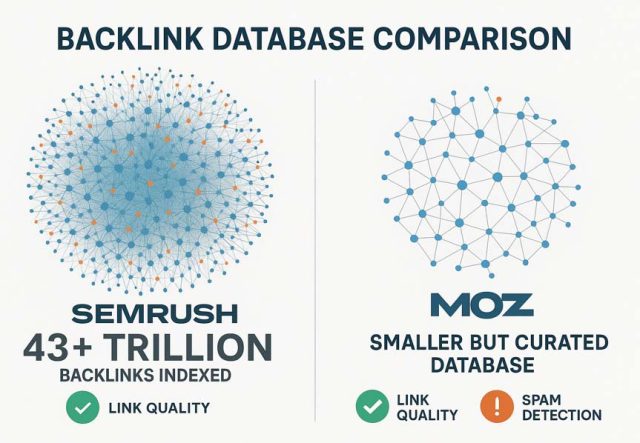
Semrush doesn't mess around when it comes to positioning itself as the everything-and-the-kitchen-sink solution for digital marketing. And honestly? The numbers back up that bold claim. We're talking 26.2 billion keywords in their database and 43 trillion backlinks indexed. It's built for businesses that need to dive deep into data and aren't afraid of a little complexity.
What makes Semrush shine:
- Keyword database that's frankly ridiculous with 25+ billion unique keywords across multiple search engines
- Competitor analysis that borders on stalking (in the best way) including traffic analytics and market research tools
- PPC capabilities baked right in with advertising insights and campaign management
- Content marketing toolkit that includes AI-powered topic research and an SEO writing assistant
- Technical SEO auditing with site crawl capabilities that'll find issues you didn't even know existed
The Price Tag Reality
Semrush's pricing makes it clear they're going after serious businesses:
- Pro Plan: $139.95/month (5 projects, 500 keywords to track)
- Guru Plan: $249.95/month (15 projects, 1,500 keywords)
- Business Plan: $499.95/month (40 projects, 5,000 keywords)
If you pay annually, you'll save about 17%, bringing that Guru plan down to $207/month. Still not pocket change, but the value starts to make sense when you consider what you're getting.
What People Actually Say About Using It
One Reddit user nailed the Semrush experience perfectly:
"SEMRush is like driving a BMW, Moz (and AhRefs to generalize) are like driving a Honda, both get you where you need to go, both more or less do the same thing. SEMRush, in my opinion does it better and saves you more time. Specifically the KeywordMagic Tool."
But it's not all sunshine and rainbows. Another user pointed out the reality: "Semrush interface isn't very beginner-friendly. It's a little too technical for beginners."
That learning curve is real, folks.
Moz Review: What Makes This SEO Platform Stand Out
The Friend Who Actually Explains Things
Moz has carved out its reputation by making SEO feel less like rocket science and more like something you can actually wrap your head around. They've been at this since 2004, and honestly, half the SEO knowledge floating around the internet probably started with something Rand Fishkin wrote on the Moz Blog.
What sets Moz apart:
- Interface that doesn't make you want to throw your laptop designed for actual humans at all skill levels
- Local SEO capabilities that actually work through Moz Local integration
- Domain Authority metric that's become the gold standard everyone references
- Educational resources that don't suck including Moz Academy courses that are genuinely helpful
- Clean reporting that focuses on what you can actually do with the information
Moz Pro Pricing That Won't Break the Bank
Moz keeps things more accessible:
- Standard: $99/month (3 campaigns, 300 keywords)
- Medium: $179/month (10 campaigns, 1,500 keywords)
- Large: $299/month (25 campaigns, 3,000 keywords)
- Premium: $599/month (100 campaigns, 6,500 keywords)
The Real User Experience
A Capterra reviewer captured it well: "Moz Pro has a more intuitive & user-friendly interface than other SEO tools and is a great option for an in-house team of mid-level SEOs."
Though even Moz isn't perfect. One reviewer noted: "Due to its many features, Moz-Pro can sometimes be overwhelming for new users, and while a learning curve exists, it's generally considered more beginner-friendly than alternatives."
Best Keyword Research Tool: Semrush vs Moz Head-to-Head
The Numbers Game
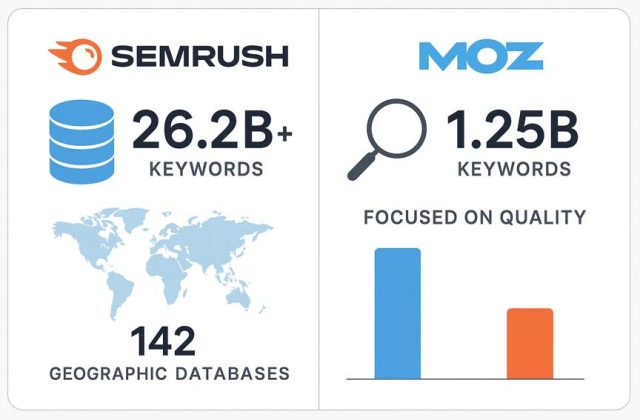
Here's where things get interesting:
- Semrush: 26.2+ billion keywords across 142 geographic databases
- Moz: Around 1.25 billion keywords, but they focus on quality over quantity
Reddit users are pretty vocal about this difference. One person put it bluntly: "Semrush offers the BIGGEST database. I find Ahrefs and Semrush's data MORE accurate than Moz's."
How They Actually Work
Semrush's Keyword Magic Tool gets tons of love for its filtering capabilities. You can slice and dice by:
- What people are actually trying to do (intent matching)
- Question-based searches
- Broad match variations
- What shows up in search results (SERP features)
Moz's Keyword Explorer takes a different approach—smaller dataset, but they really focus on giving you accurate difficulty scores and solid SERP analysis. It's great for:
- Keyword difficulty that you can actually trust
- Clear identification of SERP features
- Priority scores that help you focus on the right opportunities
The Bottom Line
For sheer volume and variety: Semrush wins hands down
For accuracy and keeping things simple: Moz holds its own
For beginners: Moz's cleaner interface is less intimidating
For power users: Semrush's advanced filters give you more control
Link Building Tools: Which Platform Helps You Build Better Backlinks
Semrush's Complete Link Building Machine
Semrush treats link building like a full-blown campaign:
Backlink Gap Analysis - Shows you exactly where competitors have links and you don't Link Building Tool - Manages your outreach right in the platform Brand Monitoring - Catches mentions you can turn into links Toxic Link Detection - Flags the bad stuff before it hurts you
A Reddit user was pretty enthusiastic: "Right now the LinkBuilding analysis system in SemRush has no direct competition. Its latest update is impressive."
Moz's Link-First Philosophy
Moz built their whole reputation on understanding links:
Link Explorer - Solid backlink analysis with their spam score system Link Intersect - Finds sites linking to competitors but ignoring you Domain Authority - The metric everyone uses to judge link value Disavow File Generator - Helps clean up your link profile
Database Showdown
- Semrush: 43+ trillion backlinks indexed
- Moz: Smaller but more carefully curated database
What This Means in Practice
The difference becomes obvious when you're actually using these tools. Semrush gives you more raw data and deeper competitor insights, while Moz offers cleaner, more actionable information with better spam detection built in.
Best SEO Tools for Small Businesses: Budget and Value Analysis
Breaking Down the Real Costs
When you actually calculate what you're getting:
Semrush Pro ($139.95/month):
Price robust tools and apps;
The same behemoth features of bigger apps, but with a lower price tag that doesn't kill your wallet.
Take advantage of the company's growing presence in Europe and beyond;
Enjoy better customer service than you might with competitors overseas.
Everyone you know is already using it, so you're practically rolling with O365 before you even see the contract. And you love that feeling when you see something that isn't Gmail but functions way better than Gmail.
Semrush Pro ($139.95/month):
- SEO toolkit + PPC + Content tools + Social media monitoring
- Five projects, 500 keywords
- Cost per feature category: $35/month
The Semrush Pro account gives you access to the aforementioned features as well as the ability to create five projects with 500 keywords each (a total of 2,500 keywords) and track their performance. This is an excellent tool for tracking multiple domains if that's your goal; it's also quite useful for tracking individual pages and their organic rankings.
Moz Standard costs $99 per month. It includes the core suite of tools for local SEO and allows users to create three campaigns and track up to 300 keywords across them. In terms of cost, the Standard plan is already over half the price of our baseline of $49 per feature category and something of a deal if you rely on Moz for local SEO.
Small Business Reality Check
The life of a new small business is much like a rollercoaster. Many people in our neighborhoods start small businesses, and most of these get off the ground and stay up for the first year. After that, many of them fall—sometimes one by one, sometimes in whole groups—straight into the abyss. The simple reason is that they do not generate the kind of cash that keeps a going concern going, mainly because their costs of doing business are way, way too high.
At present, our firm pays a monthly charge of $149 for the Moz Pro Medium plan. Comparing that plan with the SEMrush Pro Plan, we get more value for money from the Moz. In the SEMrush "feature list" that is accessible, many of the "features" that come with a Pro Plan can be found in other tools. I utilize a good number of those features; however, they are not unique, and I can access them in other mediums. Thus, if we were to change, it would mean paying for the same types of features per month—meaning I'd be spending $229 instead of $149 for Moz. The figure of $191 a month for SEMrush (if we went the annual charge way and paid up front) would save us twenty grand after five years compared with staying on Moz.
The Hidden Costs
It takes longer to figure out, but once you do, you can use it for a marketing kit. The rest of it is why you're investing the time: It's an all-in-one platform that's sophisticated enough to give you a good amount of data when you're researching things like your competition's paid search strategy, your own organic search keyword investment, and even the number of shares something got on social media. You can work with those tools one at a time or use a hub like Semrush to run many at once, which cuts down on your pre-campaign research time considerably.
For beginners, Moz can offer a faster path to successful outcomes. It provides sufficient guidance and resources to get started. Nonetheless, people who choose Moz have sometimes needed extra help to achieve comprehensive outcomes and better reach. Fortunately, the types of tools required to accomplish these extra efforts—such as in-depth competitive analysis—are already included in the Moz SEO suite.
ROI Considerations
- Businesses should consider quick startup costs (Moz offers rapid-fire onboarding)
- The amount of actual work that can be done inside the tool (Semrush is a proper, viable replacement for all the activities a business might want to do)
- How well the tool can scale with the business (if a business wants to grow, Semrush grows with them).
The Verdict: Which SEO Platform Should You Choose?
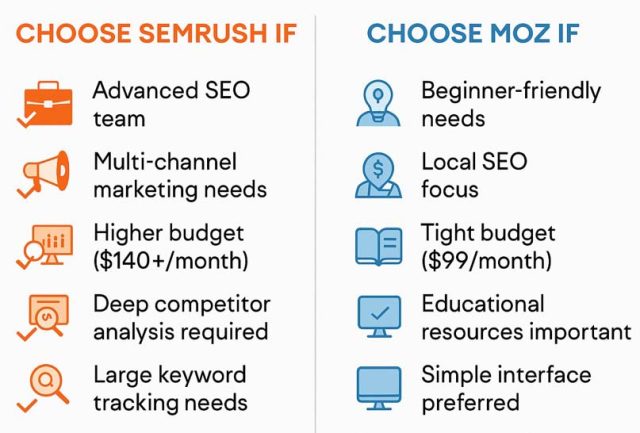
Choose Semrush If:
You're juggling several pieces of digital marketing, SEO, PPC, content marketing, and social media, but no matter how skilled you are or how hard you work, you're up against a serious challenge: showing the value of your work to company leadership. It's safe to say that most marketing challenges also turn out to be unavoidable credibility challenges. And the main reason for this is that most people simply don't understand marketing, which gives a false impression of it being something near to "easy."
for marketing teams to make investments in data platforms and decision science. Investing in decision science and data engineering helps maximize marketing efficacy, meaning that the money you use to build your next data platform is basically just another investment equal to your marketing spend in ensuring that you connect with your customers effectively, using the most relevant and current data with which to make your decisions.
You have the opportunity to devote time to understanding the Surface Pro.
The budget permits extensive tooling ($140+/month) without causing any financial strain. If you've been doing some very basic math, you'll already know this. We have set aside a healthy margin between talks and a very generous budget to burn through this month. Here's how we spent it.
Your group possesses intermediate to advanced understanding of search engine optimization.
Choose Moz If:
You are either new to SEO or have a small team handling it. The task of optimizing a website often falls to the webmaster, who, in addition to maintaining the website, must think like a search engine. Small businesses can't always afford to hire an SEO consultant. When the website is optimized, hopefully, it will attract relevant traffic, which (if you're in business) means relevant prospects and customers.
Local search engine optimization is one of our most important tasks, and when making sure that local clients find us, we go beyond the typical SEO strategies.
When local clients perform an online search, we want our name near the top of the first Search Engine Results Page (SERP). We achieve that using several services combined with superior knowledge of the local area and businesses within it.
Some of our local SEO services include:
- Google Business Profile (GBP) optimization
- Local listing management
- Local citation building
- Reviews and reputation management
- Ensuring ways and means to service the local client
Desire straightforwardness more than plentiful attributes
The budget is very tight, with a starting point of $99/month, and this serves as a substantial constraint on our plans for the future of this endeavor. On the one hand, a tight budget might simply force us to think more creatively, which might result in better ideas and a better end product; on the other hand, a tight budget might force us to think in a straight line from here to there, which might result in us doing fairly predictable things with fairly predictable outcomes.
"Educational resources and community are important to the wellness of our lives, and unfortunately, as an educational foundation, we've seen community wellness be marginalized."
The Hybrid Approach
Some seasoned individuals make use of both tools to their full advantage.
Moz tools are great for everyday use. They are reliable and provide clean data that can be used for all kinds of analysis. Moz's reports are easy to read and it is very easy to find what you are looking for. Also, in our above example, only Helixserve's backlink data is considered, while some other tools might also include data from the linking pages, thus rendering them as part of the Helixserve's backlink profile. This is good backlink research. Moz gives you the capacity to get the depth and dimension of a given backlink profile. The half-million-dollar-video is a perfect example for everyday SEO work in the second decade of the 21st century.
For profound competitor analysis and unfettered exploration, Semrush is a reliable ally. It can uncover unimaginable amounts of information on competitors with just a few clicks and enables further investigation into those findings at nearly every step of the way. The platform harbors a wealth of tools that allow for everything from quick checks on the competition to detailed research into their strategies and tactics. Yet, despite its seemingly boundless functionality and nearly all-access pass to the competition, Semrush remains a relatively unsung hero, mostly because it takes a backseat in
Final Takeaway
Both Semrush and Moz bring powerful SEO capabilities to the table, but their strengths serve different needs. Choosing the right tool depends on your goals, your team’s expertise, and your budget. Know your priorities, and the right platform will follow.
Note: The pricing information provided in this article is updated and accurate as of July 2025, based on official listings. However, prices are subject to change. For the most current pricing details, please visit the official websites: SEMrush Pricing and Moz Pro Pricing.
