

How AI, smart search, personalization and agentic commerce are redefining hotel marketing and the digital guest journey
In 2026, the hospitality world is experiencing a fundamental shift in the structure of digital marketing and the approach to guest experience. Target audiences aren't just searching for a room anymore - they expect a personalized, instant, and intuitive search and booking process that seamlessly integrates with the digital tools they use daily.
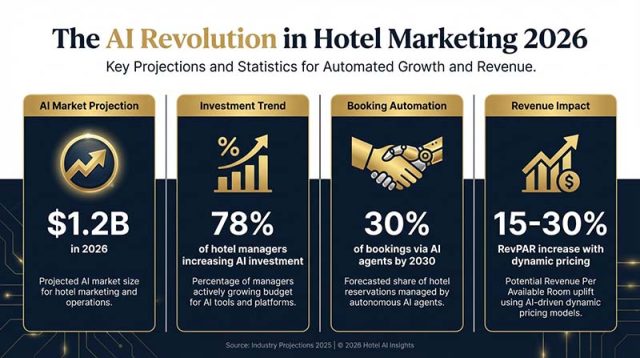
The numbers tell the story of a real revolution: the AI market in hospitality is projected to surpass $1.2 billion in 2026, and 78% of hotel managers are increasing their AI investments this year. Smart systems enable not just responses to questions but also understanding intent, executing actions in real time, and delivering personalized offers, resulting in significant improvements in service, revenue, and customer retention.
While AI is taking center stage in hotel marketing, the focus is also shifting in other directions: smart use of data, creating content that speaks the user's language, integration across multiple digital platforms, and optimizing the guest experience from the first moment they're exposed to the hotel until after they've left.
Agentic Commerce - How Bookings Will Work in the Future
One of the fastest-growing and most impactful trends in the hotel market in 2026 is Agentic Commerce, a model where AI agents act on behalf of the customer to search, compare, and even complete bookings for rooms and services. This tool doesn't just streamline search and booking; it changes how people look for hotels online. Instead of searching for dates and destinations, guests can ask a natural question like "Find me a romantic beachfront hotel for two at a reasonable price for next week," and the AI will do the work.
IDC predicts that 30% of travel bookings in 2030 will be executed by AI agents. The implication: hotels that aren't available in the "AI layer", with structured, real-time data that's machine-readable - simply won't appear on the guest's list of options.
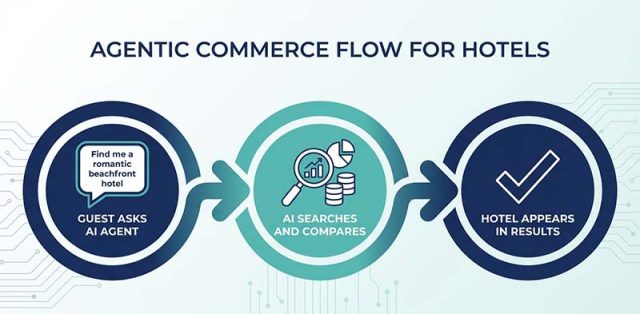
How to Be Visible to Agentic Commerce:
- Complete and Updated Structured Data – Schema.org markup for all critical information: room types, prices, availability, amenities, reviews
- Real-Time API Access – AI agents need access to inventory and pricing
- Natural Language Content – Full answers to questions guests ask, not just keywords
- Presence on AI Platforms – Google Travel, ChatGPT plugins, AI-powered booking systems
This doesn't just reduce dependence on classic search engines or OTAs; it also marks the beginning of an era where the experience happens before the guest "enters" the hotel's traditional website.
Real Time Personalization - The New Standard for Hotel Marketing
Using AI to understand and tailor personal experiences in real time is no longer just a trend - it's expected to become an industry standard by the end of 2026. This component drives marketing capabilities tailored to each guest's specific interests, based on digital behavior, past preferences, and data from all the hotel's digital channels.
Unlike static personalization (like an email with a generic offer), AI enables dynamic adaptation of messages, offers, and services, such as:
- Real-time upgrade offers on the website based on the user's stage in the process
- Customized landing pages and messages for different target audiences based on search behavior
- Marketing emails tailored to the guest's interests
This approach is based on smart data analysis that provides insights not just about who the guest is, but when and about what to contact them, leading to higher engagement and better conversions.
The Role of CDP in Personalization
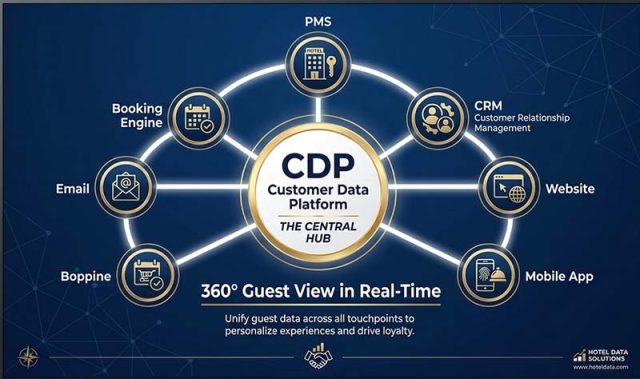
For personalization to work, the hotel needs a Customer Data Platform (CDP), a system that unifies all guest data from different sources (PMS, CRM, website, app, email) into a single, real-time view.
Without a CDP, the hotel works with fragmented information: the booking system doesn't talk to the marketing system, and the guest receives irrelevant messages. With an AI-driven CDP, the hotel can anticipate needs even before the guest requests them, like offering an upgrade to a room with an ocean view to a guest who booked one in the past.
Real World Example: Hyatt Hotels
Hyatt Hotels partnered with AWS and implemented a Machine Learning-based personalization system that analyzed booking history, digital behavior, and preferences of millions of guests. The result: $40 million in incremental revenue in just 6 months. The system offered personalized upgrades, targeted marketing messages, and customized packages based on previous preferences - tangible proof of the power of AI-driven personalization.
Smart Search and AI Discovery - A New Reality of Digital Visibility
The demand for good digital visibility no longer comes down to just high rankings in regular search results. With the emergence of AI-powered search engines (ChatGPT, Gemini, Perplexity) and systems that help travelers plan and make decisions before arriving at the hotel's website, hotels need to be available and displayed on AI platforms as well.
Additionally:
- It's crucial to create content tailored to natural questions and answers, not just classic search terms
- Using Structured Data on the website allows AI tools to better understand the services the hotel offers and display rich information in responses
- Voice search is growing - 40% of hotel searches on mobile are done by voice, and hotels optimized for this will appear in the top results
This approach creates a shift from classic SEO to a way of thinking where the hotel's information appears within conversational systems or smart search, even before the user types traditional keywords.
Smart Integration and the Hotel's Technology Stack
In 2026, it's no longer just about implementing one or two tools, but about strategic integration of the hotel's entire technology system: PMS, CRM, RMS, CDP, Booking Engine, and Marketing Stack.
This approach ensures continuous data flow and a seamless user experience throughout the entire guest journey, from the moment they search for information until after their stay, and enables capabilities such as:
- Highly accurate personalized messaging
- Demand forecasting based on historical and behavioral data
- AI-based dynamic pricing – research shows that hotels with dynamic pricing increase RevPAR by 15-30%
- Connecting marketing to operations to enhance loyalty and quality service
The shift from isolated use of individual technologies to connected layers of information and action is one of the factors that will determine who succeeds in gaining a competitive advantage in hotel digital marketing in 2026.
Smart AI-Powered Review Management - An Underutilized Asset
93% of travelers read reviews before booking, but most hotels don't analyze them systematically. AI can scan thousands of reviews in minutes, identify trends ("10 people complained about noise this week" vs. "a single complaint"), rank by severity, and suggest tailored responses.
Key Capabilities:
- Real-time Sentiment Analysis – Identifying emotions and ranking by severity
- Trend and Category Identification – Early alerts about recurring issues
- Automated Tailored Responses – Maintaining consistent tone and quick response time
- Future Score Prediction – Alerts before a problem becomes critical
Hotels using AI for review management report a 15-20% improvement in average scores within 6 months.
Real Time Competitive Intelligence
In the competitive landscape of 2026, knowing what competitors are doing in real time is a critical advantage. AI can scan and analyze competitors' websites, prices, campaigns, and reviews - and present actionable insights in real time.
Key Capabilities:
- Automated Rate Shopping – 24/7 competitor price monitoring with real-time alerts
- Availability Monitoring – Identifying opportunities to raise prices on high-demand days
- Campaign Analysis – What competitors are advertising and on which channels
- Review Monitoring – Where competitors are strong and weak
Tools like OTA Insight and RateGain allow you to see when a competitor lowers prices, launches a campaign, or receives negative reviews - and respond immediately.
Advanced Digital Marketing on the Practical Side
Beyond AI and smart search, several digital trends are rising significantly in 2026:
- Social Commerce and Messaging Commerce – Using messaging and social platforms for bookings and services (including AI chat support + manual handling as needed) shows increases in conversions and accessibility
- Mobile-First and Seamless Digital Journeys – Using mobile apps for post-booking services, check-in, upsells, and payments is now a basic expectation for digital guests
- AI-Generated Content – Creating video, images, and marketing content tailored to different target audiences at scale
How Do You Measure Success? An ROI Framework for AI in Hotel Marketing
One of the biggest challenges in implementing AI: managers invest but don't know how to measure success. Here's a clear measurement framework with key performance metrics:
Conversions and Revenue:
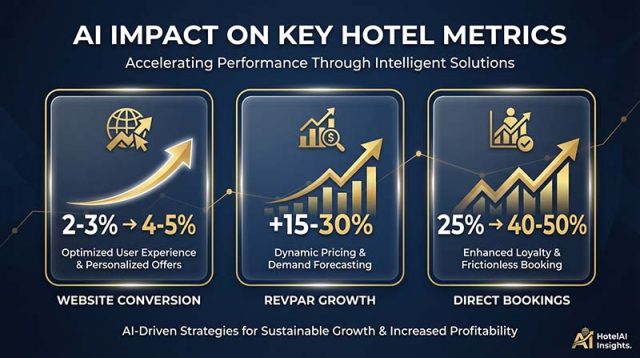
Website Conversion Rate – Hotels using AI report an increase from 2-3% to 4-5%. This means that out of every 100 website visitors, 5 will book instead of 2-3. The revenue difference is significant.
RevPAR (Revenue Per Available Room) – AI-based dynamic pricing increases RevPAR by 15-30%. The system adjusts prices in real time based on demand, competitors, local events, and weather.
Direct Booking Percentage – An increase from 25-30% to 40-50% of bookings. Less dependence on OTAs, more control over guest experience, and higher profitability.
Marketing and Engagement:
Cost Per Acquisition (CAC) – A decrease from $150-200 to $80-120 per new customer. AI enables better targeting and less budget waste on irrelevant audiences.
Email Marketing Performance – Open rate rises from 15-18% to 25-30%, and click rate from 2-3% to 5-7%. AI-driven personalization gets people to read and act.
Guest Inquiry Response Time – A drop from 4-6 hours to less than 15 minutes. Chatbots and AI assistants respond instantly, improving satisfaction and increasing conversion likelihood.
Customer Retention:
Customer Lifetime Value (CLV) – An increase from $2,500 to $3,500+ over the customer's lifetime. AI identifies opportunities for additional experiences and boosts loyalty.
Repeat Guest Rate – An increase from 20-25% to 35-40%. Personalization and excellent experience bring guests back.
Review Score – Improvement from 4.2/5 to 4.5+/5 through smart review management. AI identifies issues early and enables fixes before they escalate.
Sample ROI Calculation:
A boutique hotel with 50 rooms invests $300,000 per year in an integrated AI system (CDP + smart RMS + Marketing Automation + chatbot). If RevPAR increases by 20%, CAC drops by 30%, and Repeat Guests rise by 15%, the result is approximately $2.4 million in additional annual revenue - an ROI of 700%+.
The key: Start with a clear measurement of the current state - implement AI - measure again after 3-6 months - adjust strategy.
The Challenges of Implementing AI - The Other Side of the Coin
Despite the potential, implementing AI comes with challenges worth recognizing:
- Technological Complexity – Legacy systems not designed to work with AI
- Costs – High initial investment that small hotels struggle to justify
- Skills Gap – The divide between hotel marketing professionals and AI specialists
- Privacy and Data Security – GDPR regulations and potential data breaches
- Fear of Losing the Human Touch – Excessive AI use can create a cold experience
The Solution: The 80/20 rule – 80% of repetitive tasks to automation, 20% requiring human empathy to people.
First Steps - What You Can Do Right Away
5 Practical Steps to Get Started:
- Check Your Data Quality– Is guest data stored in one place or scattered? Do PMS and CRM talk to each other?
- Implement Structured Data on Your Website– Schema markup that makes your site readable to AI. High ROI, low cost (a few hours of technical work).
- Start with One AI Tool– Choose one pain point: website chatbot / review analysis / email personalization. Define KPIs, test for 90 days, measure results.
- Improve Email Personalization– Segment target audiences and offer upgrades, packages, or experiences based on previous booking history.
- Train Your Team– AI doesn't replace people; it empowers them. Organize an internal AI workshop or bring in an expert speaker.
Quick Wins - Actions You Can Implement This Week
Sunday - Check if your website has Schema markup using Google's testing tool. If not, pass it to your technical team.
Monday – Activate the AI features already built into your email system. Mailchimp and HubSpot include built-in AI - most hotels don't use it.
Tuesday – Schedule a demo of one tool: TrustYou for reviews / Intercom for chatbot / OTA Insight for competitive intelligence.
Wednesday – Check if your PMS and CRM talk to each other. If not, that's your next project.
Thursday – Gather the team for a 30-minute conversation: "Which repetitive tasks take up the most time?" These are the candidates for automation.
5 Common Mistakes to Avoid
- Starting with the Tool Instead of the Problem
Don't say "Let's implement a chatbot." Ask "We have 200 repetitive inquiries per week - how do we solve this?" - Buying a Solution Without Checking Integration
An amazing AI tool that doesn't talk to your PMS = money down the drain. - Not Defining KPIs Before Investment
If you didn't measure the situation before, you can't prove ROI after. - Giving Up the Human Touch
AI should be a support layer, not a complete replacement for people. Routine tasks to machines, special moments to humans. - Expecting Immediate Results
AI needs time to learn. Give it 3-6 months before deciding if it works.
Summary: The Opportunity of the Decade
In 2026, digital marketing in hotels is undergoing a fundamental and significant evolution: a shift from classic advertising and content standards to AI technologies that manage interactions, execute actions and services, and expose the hotel to travelers through new channels - sometimes even before travelers arrive at the website.
The situation demands a strategic combination of tools, infrastructure, content, and tailored experience. Success isn't just about implementing one system but about harnessing AI as an integral part of the process - where every digital touchpoint contributes to strengthening the guest experience and the hotel's business results.
The hotels that will succeed in 2026 are those that know how to have a conversation with AI - because in a world of autonomous buyers, properties with autonomous sellers will command a premium.