

This article is the second in a series of 12 articles, based on comprehensive research into Direct Bookings Growth Strategy conducted by Schieber Research and Carmelon Digital Marketing. Each article in the series takes a deep dive into one of the report's key chapters.
The hotel industry is in the middle of a structural shift, one that's quietly rewriting the relationship between hotels and the platforms they've depended on for years. Online Travel Agencies (OTAs) built a system that worked very well for them: they controlled visibility, they set the terms, and through Rate Parity clauses, they made sure hotels couldn't offer a better price anywhere else - not on their own website, not to loyalty members, not through any direct channel. For most hotels, there was no real way around it.
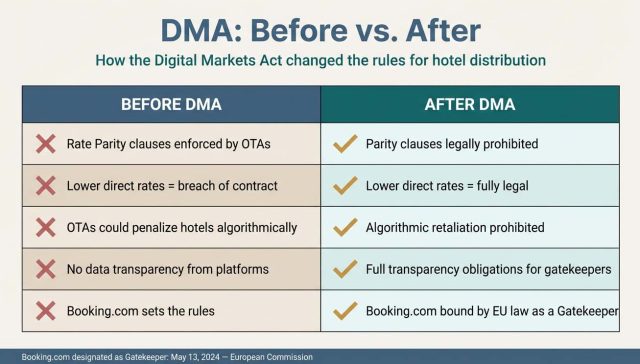
That system is now under serious legal pressure. Europe's Digital Markets Act (DMA) has introduced a new regulatory framework that directly challenges the power OTAs have held over hotel distribution. Since Booking.com was officially designated as a "gatekeeper" in 2024, it is now bound by obligations it never faced before: full transparency with business partners, fair treatment across all distribution channels, and a prohibition on enforcing Rate Parity clauses. For the first time in years, hotels have genuine legal backing to price their direct channel competitively - without risking a breach of contract.
But here's what this article is really about: legal freedom is not the same as strategic advantage. Hotels that move too quickly, slashing public rates the moment they hear "parity clauses are gone", may find themselves paying a different price. OTA algorithms operate independently of EU law, and Google's shift to CPC and ROAS bidding in early 2025 has added a new layer of financial risk for any hotel that isn't monitoring its rates in real time.
In this article, you'll find the full picture: what the DMA actually changed and what it didn't, where the real opportunities lie, and how a strategy the *Direct Bookings Growth Strategy 2026* research by Carmelon Digital Marketing and Schieber Research calls "Fenced Value" allows hotels to grow direct bookings and improve operating profit, without sacrificing visibility on the platforms that still drive discovery.
Booking.com as a Gatekeeper: What It Actually Changes
The gatekeeper designation isn't just a label, it comes with real, enforceable obligations. Booking.com must now operate transparently with its business partners, treat all distribution channels fairly, and stop imposing contract terms that restrict competition. In plain terms: they can no longer legally prevent you from pricing your own rooms however you choose on your own website. If they try, they're looking at billion-dollar fines. This regulation isn't gathering dust, it's active, it has teeth, and enforcement is already underway.
Rate Parity Is Gone: Real Pricing Freedom and How to Use It Right
Rate Parity always sounded reasonable on the surface. Equal prices everywhere, fair for everyone, right? In practice, it was a mechanism that locked hotels out of their own pricing strategy. You couldn't reward a guest for booking directly. You couldn't run a members-only deal. You couldn't do anything on your own site that made the direct channel more attractive than the OTA.
Article 5(3) of the DMA ends that. It explicitly prohibits gatekeepers from stopping business users, hotels, from offering better prices or conditions through any other channel, including their own. Today, if you want to show a lower rate on your direct site than on Booking.com, you're on solid legal ground. No breach of contract, no basis for a claim. The OTA simply cannot stop you.
The Catch: Algorithms Don't Care About Regulations
Here's where hotels need to be careful. The DMA removes a legal barrier, it doesn't touch the OTA's algorithm. If you start publicly advertising lower rates on your direct site, the platform can still quietly demote your property in its search rankings. No legal violation, no paper trail. Just less visibility, fewer clicks, and lower booking volume across the board.
There's a second pressure point worth understanding: Google's move away from commission-based bidding. As of February 2025, Google officially ended its Pay-Per-Stay model for Hotel Ads, the arrangement where you only paid when a booking was completed. Hotels are now on CPC (Cost-Per-Click) and ROAS (Return on Ad Spend) models, meaning you pay for every click whether or not a booking follows. The media risk now sits entirely with you.
Why does this connect to the DMA conversation? Because if a third-party wholesaler breaks your rate parity without your knowledge, and your direct price appears higher than the OTA's on Google Hotel Ads, guests click the OTA. You absorb the click cost and lose the booking, simultaneously. Real-time rate monitoring isn't a nice-to-have anymore. In this environment, it's a basic operational requirement.
The Right Move: Fenced Value, Not a Price War
The Direct Bookings Growth Strategy 2026 by Carmelon Digital Marketing and Schieber Research is clear on this: the hotels that gain the most from the DMA won't be the ones that slash public rates. They'll be the ones that build a Fenced Value model, delivering better value through the direct channel in ways that OTA algorithms can't see or penalize.
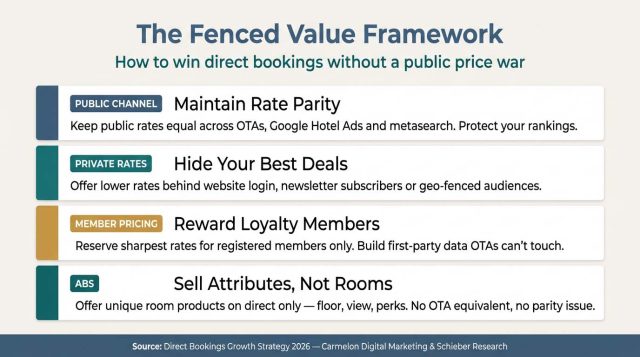
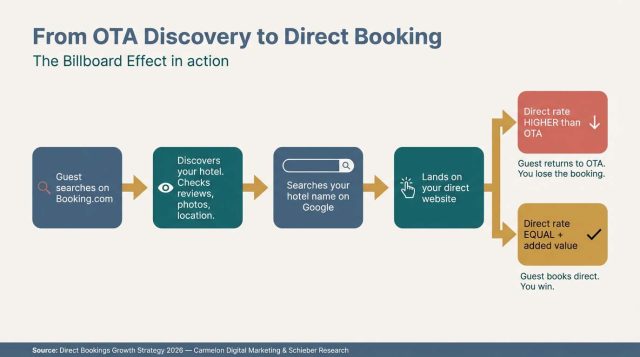
Keep public rates at parity On open channels, OTAs, Google Hotel Ads, metasearch, hold your publicly visible rates steady. The Billboard Effect ( the well-documented phenomenon where guests discover a hotel on an OTA, then search directly for the hotel's own website to compare or book) still works: guests discover you on Booking.com, then search for your direct price. Give them the same number, and you have a shot at converting them. Give them a higher one, and they're gone.
Put your best rates behind a fence. Lower rates can live behind a website login, inside a newsletter, or within geo-fenced audiences (guests targeted by specific geographic location) . The bots OTAs use to scrape prices can't get through those barriers, so your deals stay invisible to the algorithm.
Make loyalty members your best-rate tier. Reserve your sharpest pricing for registered members only. Beyond protecting the rate, you're building a first-party database that grows more valuable with every stay, something no OTA will ever hand you.
Sell attributes, not just rooms (ABS - Attribute-Based Selling). This is arguably the most powerful tool available. Instead of listing a "Deluxe Room" across every channel, offer something on your direct site that simply doesn't exist on any OTA: "Deluxe Room, floor 10+, sea-facing, away from the elevator." The OTA sells a category. You sell a specific experience. No equivalent product means no grounds for a parity complaint. Bundling works the same way, a "Standard Room + Late Checkout + Welcome Drink" package has no OTA counterpart, so there's nothing to compare.
A real-world example from the research: Premier Inn Middle East ran a "Book Direct, Same Price, More Benefits" campaign that didn't touch public rates at all. The results: 46% growth in direct website bookings and a 262% lift in booking revenue. No price war. Just a fenced value that gave guests a clear reason to choose direct.
What to Do This Week: A Practical Starting Point
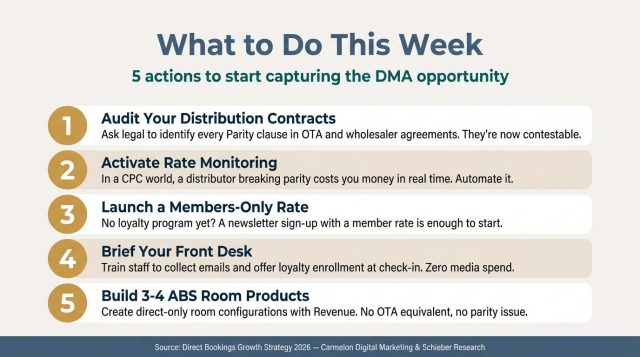
The DMA creates the opportunity. You still have to act on it. Here's where to start:
- Get legal to audit your distribution contracts.Every Parity clause still sitting in your agreements with OTAs, wholesalers, and aggregators is now legally contestable. Identify them and start the conversation about removing them.
- Put rate monitoring in place. In a CPC world, a third-party distributor breaking your parity is costing you real money right now. Automated rate monitoring is the only way to catch it.
- Launch a members-only rate. No loyalty program (a hotel's own membership club that offers exclusive rates and benefits to registered guests) yet? Even a simple newsletter sign-up with a "member rate" is a starting point. It's the highest-ROI move available to most hotels right now.
- Turn your Front Desk into a conversion channel. Every OTA guest is a potential direct customer next time. Train staff to collect email addresses and offer loyalty enrollment at check-in, zero media spend required.
- Build three or four ABS room products for your direct site. Work with Revenue to price them. You don't need to overhaul your entire inventory, start with a handful of products that have no OTA equivalent.
Why Direct Bookings Are Worth the Investment
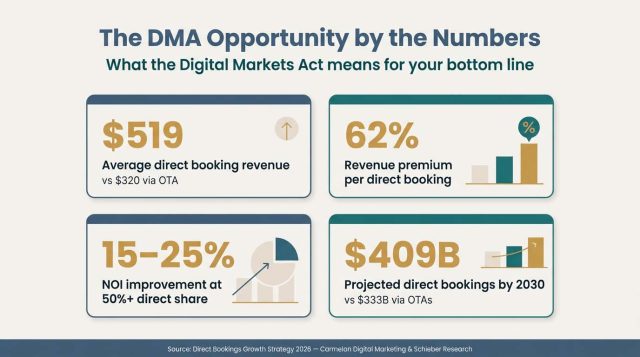
The numbers are stark: the average direct booking generates $519 in revenue, versus $320 through an OTA. That's a 62% premium, per booking, every time. Hotels that push past 50% direct booking share report 15–25% improvement in Net Operating Income (NOI). And by 2030, direct bookings are projected to overtake OTAs globally: $409 billion versus $333 billion. The DMA is one of the key forces driving that shift.
The DMA doesn't guarantee anything. It removes a barrier that's been in place for years. The tools are there, the legal ground is solid, and the window is open. Hotels that invest in the right infrastructure now, loyalty programs, rate monitoring, a stronger direct channel experience, will come out of this with better margins and less dependency on platforms. Those that wait will keep writing commission checks to the same platforms this regulation was built to rein in.
Key takeaway from the research: OTA counter-moves remain a real risk - which is exactly why outright price wars are the wrong play. The winning strategy is Fenced Value: building exclusive advantages that give guests a genuine reason to book direct.
This article is part two of an ongoing series based on the Direct Bookings Growth Strategy research by Schieber Research and Carmelon Digital Marketing, with each article focusing on one of the report's key themes. Data and statistics referenced throughout are sourced from third-party research providers, primarily Skift and SiteMinder, alongside additional industry sources.