

This article is the third in a series of 12 articles, based on comprehensive research into Direct Bookings Growth Strategy conducted by Schieber Research and Carmelon Digital Marketing. Each article in the series takes a deep dive into one of the report's key chapters.
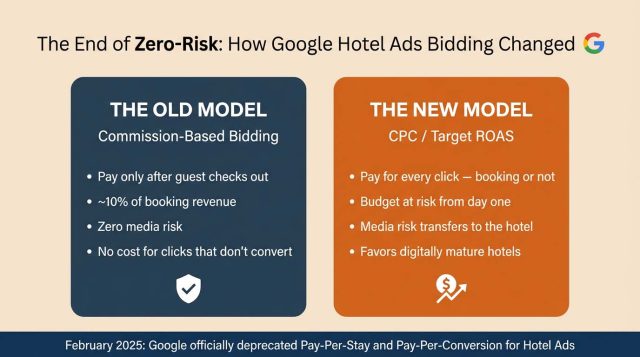
The hotel advertising landscape shifted quietly but decisively in early 2025. Google discontinued its commission-based bidding model for Hotel Ads, the Pay-Per-Stay and Pay-Per-Conversion system that allowed hotels to pay only when a guest actually completed a stay. In its place: a full transition to Cost-Per-Click (CPC) and Return on Ad Spend (ROAS) bidding. For digital managers, revenue managers, and marketing leaders in hospitality, this isn't a technical update. It's a fundamental change in how media risk is distributed, and who absorbs it.
The core challenge is straightforward: under the old model, a campaign that generated clicks but no bookings cost nothing. Today, every click draws from your budget, regardless of outcome. That means rate gaps between your direct website and OTA (Online Travel Agency) listings, often caused by wholesaler price leaks, are no longer just a revenue management headache. They're a direct and immediate drain on your advertising spend.
This article examines exactly what changed in Google Hotel Ads, what budget traps have emerged as a result, and what the data from the *Direct Bookings Growth Strategy 2026* report by Carmelon Digital Marketing and Schieber Research reveals about campaign performance in the new environment.
The good news: hotels that align their advertising and revenue strategies, invest in real-time rate monitoring, and apply smart channel management will find that Google's shift isn't a threat. It's a competitive filter, one that rewards the prepared.
The Budget Trap Most Managers Don't See Coming
There's a scenario playing out across hotels everywhere. It goes like this:
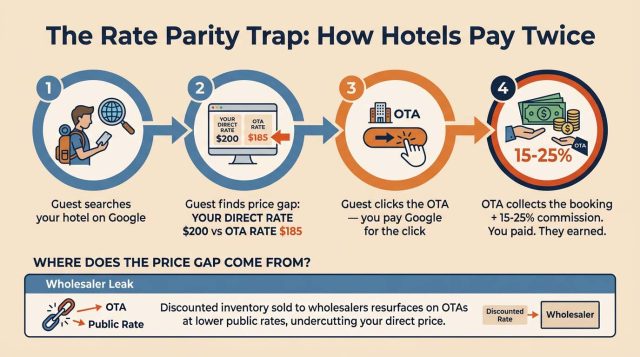
A traveler searches for your hotel on Google. The Hotel Ads panel loads, showing every available rate side by side: your direct website: $200 per night. Booking.com: $185. The traveler clicks Booking.com. Of course they do.
Here's what that click actually cost you: you paid Google for that click. The OTA got the booking, and with it, a commission of 15% to 25% of the room revenue. You funded the search. They collected the reservation.
Where did that price gap come from? Most of the time, it's a Wholesaler Leak. Hotels sell inventory to wholesalers at discounted rates, meant exclusively for closed package deals. Some wholesalers quietly resell that inventory to smaller OTAs, who then list the cheap rate publicly. In the commission era, this was annoying. In the CPC era, it costs you twice - wasted ad spend and a lost direct booking.
What Actually Changed,and Why It Matters to Your Budget
Under the old model, hotels paid Google around 10% of booking revenue - but only after the guest had checked out and paid. The financial exposure, what the industry calls Media Risk, was effectively zero. Thousands of impressions, hundreds of clicks, nobody books, you owe nothing.
That's no longer the case. All Google Hotel Ads campaigns now run on CPC (Cost Per Click) or Target ROAS (Return on Ad Spend) bidding. Spend $100 on clicks, get zero bookings, lose $100. No refund, no credit, no safety net.
According to the Direct Bookings Growth Strategy 2026 report by Carmelon Digital Marketing and Schieber Research, this shift creates a real barrier to entry for hotels that don't have the data infrastructure or digital maturity to manage that kind of risk - while handing a clear advantage to those that do.
ROAS: The One Number Every Hotel Advertiser Needs to Know
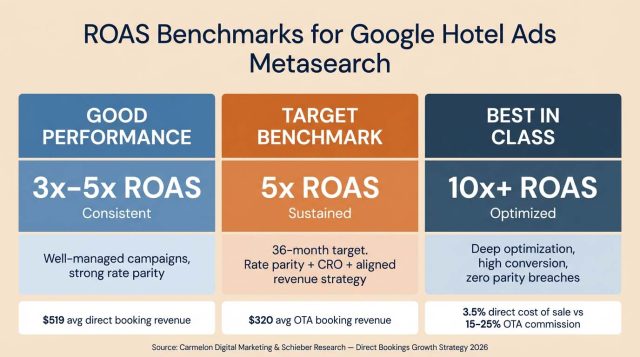
In a CPC-driven world, ROAS is your most important metric. The question it answers is simple: for every dollar you put into advertising, how many dollars come back as direct booking revenue?
According to the research, well-run metasearch campaigns should consistently deliver a ROAS of 3x to 5x. The report's 36-month benchmark sets the target at a sustained 5x - not just hitting it once, but holding it over time. Hotels that invest in conversion rate optimization, a smooth booking experience, and tight rate parity can push well past that, reaching 10x and beyond.
But a 10x ROAS doesn't come from bidding alone. It comes from the full picture: smart campaign management, a competitive direct rate, and a website that actually closes. Take any one of those out and your ROAS drops, along with your budget.
Four Steps to Take Right Now
- Rate parity monitoring is no longer optional
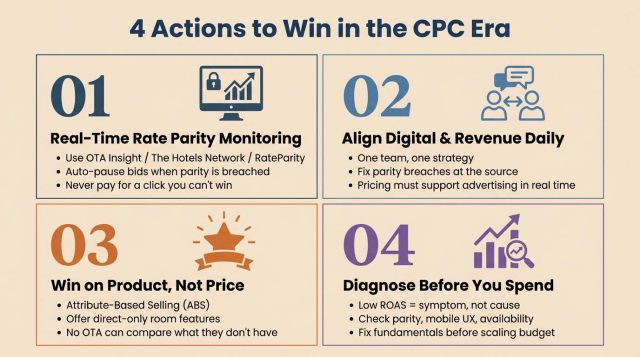
You can't run a CPC campaign on Google Hotel Ads without automated Rate Parity monitoring. The rule is straightforward: if your direct rate is higher than what an OTA is showing in the same results panel, your campaign shouldn't be running. You're paying to send guests somewhere else.
Tools like OTA Insight, The Hotels Network, and RateParity monitor rates in real time and connect directly to your campaigns. When a parity breach is detected, an OTA undercutting your direct rate, the system can automatically pause your bids before you spend another dollar on a click you were never going to win. The research flags these tools as essential in the ROAS bidding era.
- Digital and Revenue need to work as one team
The most common failure right now is digital managers and revenue managers operating independently, without real-time communication. Campaigns run on one side, pricing decisions happen on the other, and meanwhile a wholesaler is leaking rates that nobody's caught.
When a parity breach shows up in your Hotel Ads data, the fix has to come from the revenue side, a conversation with the wholesaler, an update through the Channel Manager (the platform that pushes your rates across all booking channels), and a correction before the next impression. Pricing strategy has to back up your advertising strategy in real time, not after the damage is done.
- When you can't win on price, win on product
Maintaining full rate parity isn't always straightforward, long-standing contracts, rigid pricing structures, OTAs sitting on old inventory. That's where Attribute-Based Selling, or ABS, comes in.
The idea is simple: offer something on your direct site that can't be compared anywhere else. Not a "Standard Room", but "8th floor, ocean view, away from the elevator." The OTA has a Standard Room. You have a specific product. Price comparison becomes irrelevant, and your direct channel becomes the only place to get it.
- Before you raise the budget, find out why ROAS is low
A weak ROAS is almost always a symptom, not the root problem. Before adding spend, ask the harder questions first: Is there a parity breach running unchecked? Is your booking page converting on mobile? Is availability showing accurately? More budget behind broken fundamentals doesn't improve performance - it just scales the loss.
The Bottom Line: This Is an Opportunity, Not Just a Challenge
Direct bookings generate 62% more revenue per reservation than OTA bookings: $519 versus $320 on average, according to the research. The cost of sale for a mature direct channel sits at around 3.5%, compared to the 15% to 25% commission OTAs take on every booking. Hotels that reach 50% or more in direct booking share report NOI (net operating income) improvements of 15% to 25%.
Metasearch is still a profitable channel, but only for hotels that are properly set up. Digital managers who build real-time rate parity monitoring into their workflow, align closely with their revenue teams, and create direct-only products through ABS will find that Google's shift isn't the problem. It's a filter that clears the path for everyone who's done the work.
This article is part three of an ongoing series based on the Direct Bookings Growth Strategy research by Schieber Research and Carmelon Digital Marketing, with each article focusing on one of the report's key themes. Data and statistics referenced throughout are sourced from third-party research providers, primarily Skift and SiteMinder, alongside additional industry sources.