

This article is the fifth in a series of 11 articles, based on comprehensive research into Direct Bookings Growth Strategy conducted by Schieber Research and Carmelon Digital Marketing. Each article in the series takes a deep dive into one of the report's key chapters.
Hotel loyalty programs are at an inflection point. What worked well for high-frequency business travelers - tiers, points accrual, deferred rewards - is increasingly disconnected from how most hotel guests actually make booking decisions today. A guest who visits once a year, comparing options on a screen that shows your direct site right next to Booking.com, isn't thinking about points they'll never accumulate enough to redeem.
According to the Direct Bookings Growth Strategy 2026 report by Carmelon Digital Marketing and Schieber Research, 69% of Millennials prefer instant gratification over future benefits. For every CMO and Loyalty Manager reading this: every dollar invested in a complex points infrastructure may be working against your Conversion Rate, not for it.
The shift happening across mid-scale hospitality is clear - chains moving from points accrual to instant value models are reporting significant jumps in direct booking share. The data behind that shift, the economics that make it work, and how to build it without breaking Rate Parity with OTAs, all of that is ahead.
The good news: this isn't a heavy lift. It's a change in approach. Stop asking your guests to believe in the future, and give them a reason to act now.
Loyalty Isn't Dead, It Changed Jobs
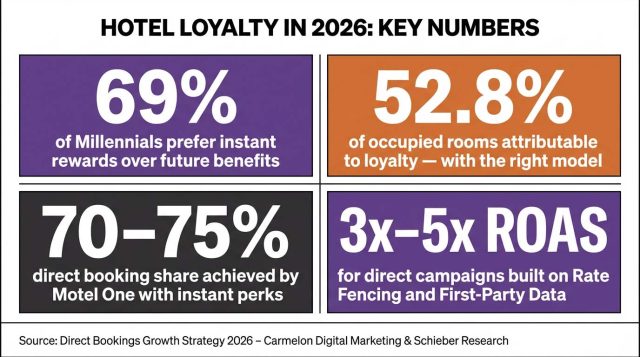
According to the research, up to 52.8% of occupied rooms can be attributed to loyalty, when the model fits how guests actually behave. That puts loyalty at the center of the direct booking strategy, not on the edges as a supporting feature. The question isn't whether to invest in loyalty. It's whether your model matches the decision your guest is making right now, not the one you're hoping they'll make in two years.
The Shift Your Guests Are Already Making
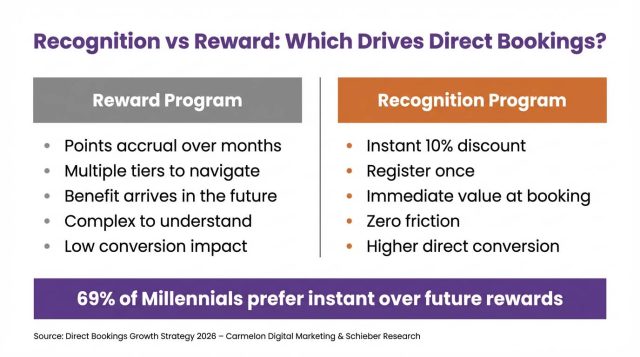
According to the research, 69% of Millennials prefer instant gratification over future benefits. That's not a niche segment, that's most of your market. For a guest who stays at a hotel once or twice a year, a points program simply doesn't compute. They won't accumulate enough to feel any benefit. The points will expire. The program will sit in their account and have zero influence on their next booking decision.
The comparison a guest makes at the point of booking isn't between two hotels. It's between a direct channel that needs to prove its value, and an OTA offering a fast interface, clear pricing, saved payment details, and zero friction. When the only advantage of booking direct is a vague promise for later, the direct channel loses that comparison nearly every time. Not because guests are disloyal. Because no one gave them a good enough reason to stop and sign up.
The Model That's Replacing Points
According to the research, the model replacing points is built on a straightforward premise: register, get something now. Sign Up & Save clubs deliver an immediate ~10% discount on the current booking, or tangible on-site benefits, the moment a guest creates an account. No tier logic, no accrual math, no deferred value.
Motel One is the clearest proof of concept. The German mid-scale chain, design-led hotels across 80 European cities, has completely rejected the points model. Its beOne membership delivers instant benefits at registration: a water bottle in the room, late checkout, a restaurant discount. The chain holds a 70%–75% direct booking share in its core markets. That's not despite the simplicity of the program. It's because of it. By eliminating the primary OTA advantage, speed and zero friction, guests get an immediate, tangible reason to book direct. One that doesn't require a spreadsheet to understand.
A 10% Discount Still Beats Any OTA Commission
The most common pushback against instant discounts is margin erosion. According to the research, the numbers tell a different story. Direct bookings generate $519 in revenue per booking, versus $320 through an OTA, a 62% gap. The cost of direct marketing sits at approximately 3.5%, compared to OTA commissions of 15%–25% on every single transaction. Hotels achieving a Direct Share (the proportion of bookings made directly with the hotel) of 50% or more report NOI (Net Operating Income) improvements of 15%–25%.
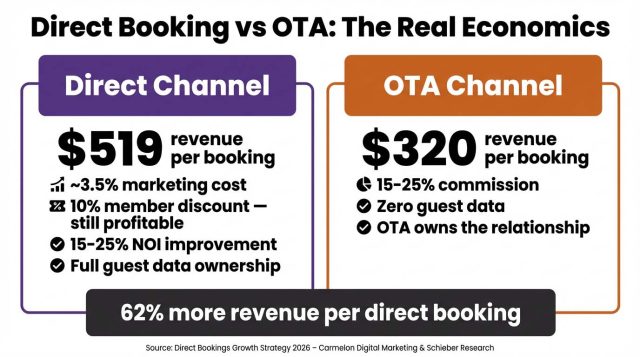
Even with a 10% member discount baked in, the math holds, comfortably. A 10% direct discount is still meaningfully cheaper than the lowest OTA commission on the market. You're delivers immediate value to the guest, keeps the direct relationship, and still earns more per booking than it would have through any OTA. The discount isn't a margin concession. It's the mechanism that protects margin.
Protecting Member Value Without a Price War
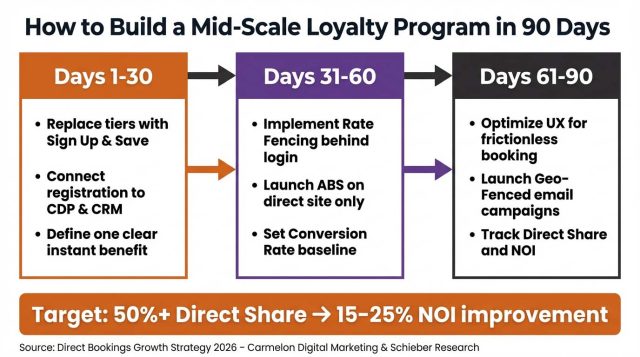
For a Sign Up & Save model to work without violating Rate Parity - the industry requirement that direct rates match OTA rates publicly, member pricing has to stay out of reach of OTA price scrapers. The solution is Rate Fencing: member rates placed behind a login screen, invisible to bots. Publicly, full parity. Privately, clear value for every guest who chose the direct channel.
Attribute-Based Selling (ABS) takes this a step further. By selling specific room attributes - a high floor, a city view, a room away from the elevator, exclusively through the direct channel, you creates a product the OTA simply doesn't carry. The OTA lists a "Standard Room." The direct site sells a specific experience. According to the research, direct booking campaigns built on Rate Fencing and ABS achieve ROAS (Return on Ad Spend) of 3x–5x, with top performers reaching 10x+
Four Steps to Make the Shift
- Replace tiers with one clear immediate benefit
Strip out the tier structure and replace it with a single visible offer positioned next to the "Book Now" button. Registration should take seconds, not a multi-field form. Every additional step in the sign-up process directly lowers Conversion Rate and sends guests back to the OTA they already have an account with.
- Define loyalty as data capture, not reward delivery
Every registration is an email address, which feeds directly into a CDP (Customer Data Platform) and CRM (Customer Relationship Management) system. Campaigns built on First-Party Data (guest information collected directly by the hotel) reach ROAS of 3x–5x, with best performers hitting 10x+. The data is the real long-term value. Not the points.
- Fence your member benefits behind a login
Member discounts stay behind a login screen. ABS inventory lives on Your direct site only. Geo-Fenced (location-targeted) offers go out via targeted email campaigns. This isn't a price war, it's product differentiation the OTA cannot replicate or display.
- Treat UX as a non-negotiable baseline
A high-friction booking process sends guests straight back to OTAs, even after they've registered. Motel One addressed this with One Click Book, a single-tap booking flow that removes the last remaining OTA advantage. If the UX (user experience) doesn't close the convenience gap, no loyalty model will compensate for it.
The Numbers That Close the Case
According to the research: 62% more revenue per direct booking, NOI improvements of 15%–25% when Direct Share exceeds 50%, and up to 52.8% of occupied rooms attributable to loyalty - when the model is right.
Points programs were built for high-frequency business travelers, guests who stay 40 or 50 nights a year and have genuine reason to chase status. For everyone else, the model adds operational complexity without moving the booking needle.
Loyalty that affects the booking happening right now is worth more than any program banking on the guest coming back on their own. The brands building that model today, and you'll hold an advantage that late movers won't easily close.
This article is the fifth in an ongoing series based on the Direct Bookings Growth Strategy research by Schieber Research and Carmelon Digital Marketing, with each article focusing on one of the report's key themes. Data and statistics referenced throughout are sourced from third-party research providers, primarily Skift and SiteMinder, alongside additional industry sources.