

This article is the fourth in a series of 12 articles, based on comprehensive research into Direct Bookings Growth Strategy conducted by Schieber Research and Carmelon Digital Marketing. Each article in the series takes a deep dive into one of the report's key chapters.
The hospitality distribution landscape is shifting, and the numbers make it hard to ignore. According to the Direct Bookings Growth Strategy 2026 report by Carmelon Digital Marketing and Schieber Research, direct digital channels are on track to overtake OTAs globally by 2030: $409 billion versus $333 billion. Two structural changes accelerated this shift in the past year: the EU Digital Markets Act, which now legally allows hotels to offer better rates on direct, and Google's deprecation of commission-based bidding on Hotel Ads, transferring media risk directly to you.
Most hotel groups are still stuck. Your campaigns are running, the website performs better than it did two years ago, and direct share has nudged up a point or two. But OTA commissions are still running at 15–25% per booking, the guest relationship still belongs to Booking.com, and building a loyalty program that competes with Marriott's 200-million-member ecosystem isn't a realistic option for most.
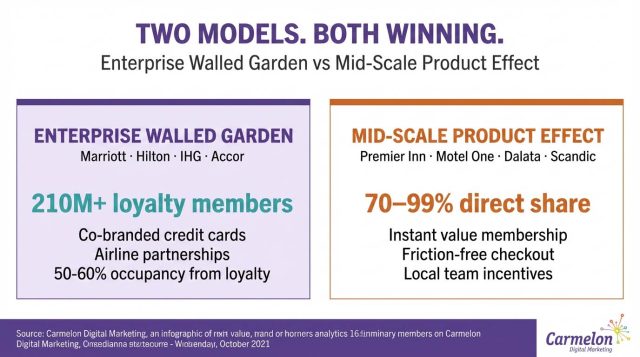
Premier Inn holds over 99% direct bookings in its UK domestic market. Motel One runs at 70–75% across Europe. Dalata reported consistent direct booking growth through 2025. Scandic built a regional ecosystem no global platform can replicate. Four chains, four distinct approaches- and a clear, repeatable pattern behind every one of them.
The data shows that crossing 50% direct booking share improves NOI (Net Operating Income) by 15–25 percentage points. The playbook is proven, the models are documented, and none of them required a 210-million-member loyalty program to get started. What they required was a management decision and the right framework.
What a Direct Booking Is Actually Worth
A direct booking generates $519. An OTA booking generates $320. That 62% gap doesn't come from room rate alone. It includes ancillary spend, lower cancellation rates, and upsell potential that OTA guests rarely trigger.
The cost of sale on direct, for digitally mature hotels, sits at around 3.5%, versus 15–25% OTA commission. Hotels that cross 50% direct share see NOI (Net Operating Income) improve by 15–25 percentage points.
This isn't a marketing play. It's a structural profitability shift.
Two Shifts That Rewrote the Playbook
Two structural shifts in the last year have changed the rules, and not everyone has caught up yet.
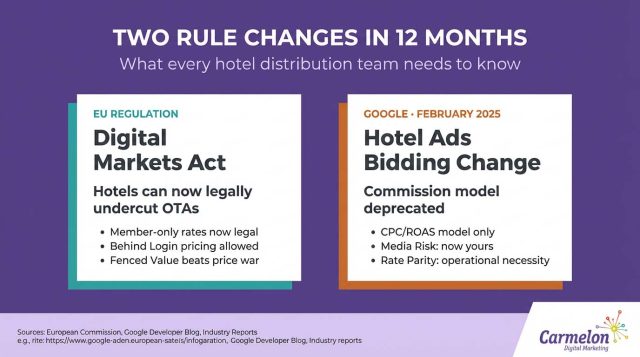
The EU Digital Markets Act (DMA): Hotels can now legally offer lower rates on their direct channel than on OTAs. Booking.com is classified as a gatekeeper under EU law, with new transparency obligations. The research recommends against public price wars, the smarter move is Fenced Value: member only rates, geo-fenced offers, Behind Login pricing. Competitive advantage without algorithmic penalty.
Google Hotel Ads - February 2025: Google deprecated commission-based bidding. Everyone on Metasearch now operates on CPC/ROAS, meaning Media Risk transfers to the hotel. If your direct rate shows higher than your OTA rate on Google, you're paying for clicks and losing the booking. Rate Parity monitoring went from best practice to operational necessity overnight.
Four Models. Four Approaches. Here's What Worked
Premier Inn: 99% Direct - No OTA, No Compromise
Premier Inn holds over 99% direct digital bookings in its domestic UK market across 900+ hotels, with 97,000 rooms projected by 2029. The strategy is deliberately blunt: exclude B2C OTA inventory entirely while staying pragmatic on B2B, integrated with Concur for corporate travel and MakeMyTrip for inbound Indian visitors.
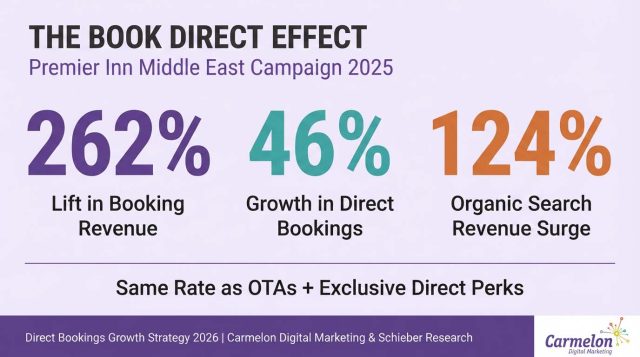
When the brand needed to build direct share in competitive markets, it didn't cut prices. The 2025 "Book Direct" campaign in the Middle East maintained full Rate Parity against OTAs but offered direct bookers exclusive perks: early check-in, late check-out, F&B discounts. Same rate, more value, direct only.
Results: 262% lift in booking revenue, 46% growth in direct bookings, 124% surge in Organic Search revenue. The takeaway is clear: Rate Parity plus exclusive value-adds eliminates the OTA price advantage entirely. Guests book direct for the experience, not a discount.
Motel One: The Perk That Arrives at Check-In
Motel One runs at 70–75% direct booking share across Europe. The core strategy is built on one clear insight: 69% of millennials prefer instant gratification over deferred rewards. So they scrapped points entirely.
"beOne" is a membership that gives guests an immediate discount and a physical perk from the very first booking - a free water bottle at check-in, not points to redeem years later. No tiers, no accumulation. The real objective, according to the research: email capture and direct marketing channel ownership.
The second move targets the main reason guests default to Booking.com, payment convenience. Stored card details make OTA checkout frictionless. Motel One answered with "One Click Book" for registered users: saved payment details, one tap to confirm. The friction that sends guests back to OTAs disappears at the moment of decision.
Together, they address the two main reasons guests choose OTAs over direct: lack of immediate value and checkout convenience.
Dalata: When the Front Desk Becomes the Sales Team
Dalata Hotel Group, operating across Ireland and the UK, reported 8% growth in direct bookings in H1 2025. That's a relative figure without a stated baseline, but the trajectory is consistent.
The engine combines centralized proprietary technology with decentralized accountability. Reception and reservations staff at each property are directly incentivized to convert OTA guests to direct bookers for their next stay. The front desk becomes a conversion channel, every OTA guest who checks out is a direct booking opportunity for their next visit. Strong infrastructure from the top, motivated people at the front desk. It's a growth driver that doesn't depend on the media budget.
Scandic and Strawberry: The Model No OTA Can Copy
In the Nordics, Scandic and Strawberry (formerly Nordic Choice) both consistently rank among the highest direct booking shares in their region, though the research doesn't cite specific percentages.
Scandic's 3 million+ Scandic Friends members are tied into a deep partnership with SAS Airlines, a local ecosystem that no global platform can match for regional travelers. Strawberry, with 250+ hotels and 3 million+ members, went further with "Spenn," a proprietary digital currency: guests earn and spend Spenn across all Strawberry brands - hotels, restaurants, experiences, keeping value locked inside the ecosystem and away from OTAs.
Regional travel partnerships create a genuine Barrier to Entry that compounds over time. It's the one direct booking strategy a global platform genuinely cannot copy.
What Separates 30% from 70% Direct Bookings
The chains achieving high direct share don't do everything - they do a few things very well. According to the research, these are the moves that consistently appear:
- Set a number, then protect your rate
"Improve direct share" is not a target. 50%, 60%, 70% is. Crossing 50% is the NOI inflection point in the research. In parallel, Rate Parity monitoring is now table stakes: a direct rate showing higher than OTA on Google means paying for clicks while losing bookings to Wholesaler Leak.
- Build a membership that drives action, not accumulation
A simple sign-up page with a clear offer, register and save, immediate discount, something tangible at check-in. No complex loyalty tiers, no points. Once the guest registers, the email is captured and a direct marketing channel begins. Add One Click Book for registered users and you remove the friction that sends guests back to Booking.com at checkout.
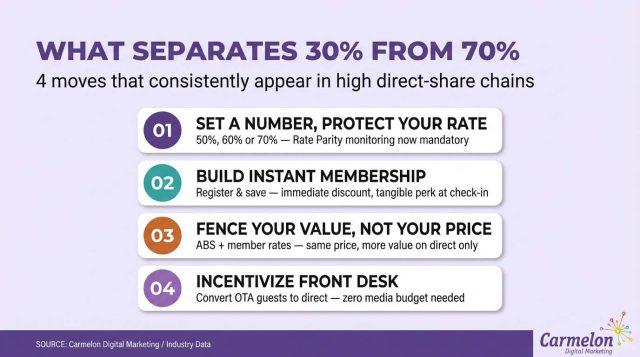
- Replace price wars with fenced value
The DMA now allows lower rates for registered members without OTA algorithmic retaliation. The stronger tool is Attribute-Based Selling (ABS): offer "sea view room, high floor, away from elevator" direct, and only "standard room" on OTAs. That's a product creating its own demand. "Same Price, More Benefits" maintains Rate Parity while delivering a genuine direct channel advantage.
- Incentivize the people in front of guests
Front desk and reservations staff are a conversion channel that doesn't appear in the media budget. The Dalata model proves that direct local incentives, converting today's OTA guest into a direct booker for their next stay, build a self-sustaining growth engine.
The Bottom Line
A direct booking generates $519. An OTA booking generates $320. The cost of sale on direct is 3.5%, versus up to 25% commission. Cross 50% direct share and NOI improves by 15–25 percentage points. By 2030, direct channels are projected to reach $409 billion globally.
High direct share isn't a marketing achievement- it's a profit strategy. Premier Inn, Motel One, and Dalata didn't get there with bigger budgets. They made a management decision to treat the direct channel as the flagship product.
Hotels that keep treating OTAs as a necessary partner will keep paying the commission. Hotels that decide otherwise will change their margin structure.
This article is the fourth in an ongoing series based on the Direct Bookings Growth Strategy research by Schieber Research and Carmelon Digital Marketing, with each article focusing on one of the report's key themes. Data and statistics referenced throughout are sourced from third-party research providers, primarily Skift and SiteMinder, alongside additional industry sources.